Notes on Cumpa: The Listening Robot
By: eunki
Cumpa is the counseling robot for emotional care that we’ve made throughout my master’s studies. This speculative note is about the place where Cumpa is to be: besides a dog and an old man losing his memories.
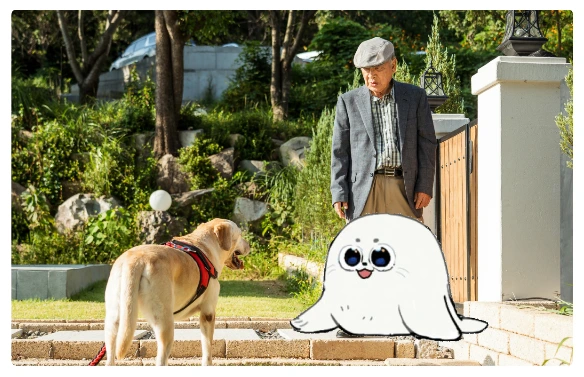
A Story of Sophie and Lee1
Sophie, a dog and Lee, an old man are the central figures of the TV drama [Dog Sound] (KBS, 2024). The drama starts with a mysterious death that no one can make sense of. It is that moment when Lee appears out of nowhere and says,
“That’s a murder, not a suicide.”
How does he know it? Actually, Sophie, the dog, is the one who first knew it and told him. Lee could hear that because he had a special ability to understand dog sounds.
No one had expected that Lee would find the truth, since he is an old man with dementia. He is cruel and nasty and sometimes even pees himself, so he has been ignored by everyone. However, he is the only person who listened to the testimony of Sophie, finding the truth that all other people could not find.
This is a story of listening, where what Sophie said hasn’t been heard by all other people but has been recognized by Lee, who’s been similarly ignored by others. This is a story of solidarity, where the voiceless beings are connected to each other through listening.
A Story of Cumpa
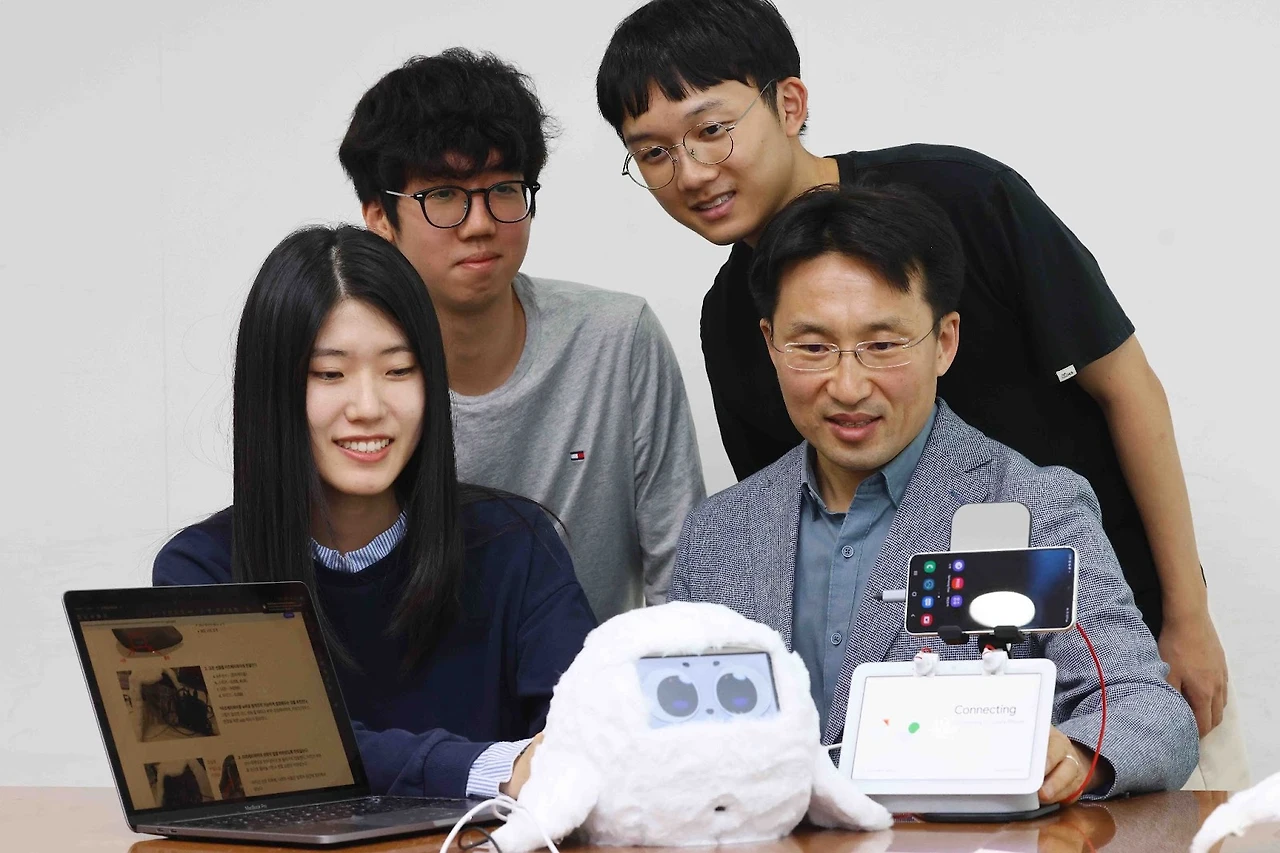
While I’ve done the research about Cumpa2, a counseling robot, I thought, ‘how might we put this robot to the place of Lee?’
Our robot is to ‘CARE’ or ‘COUNSEL’ people: so big verbs that we couldn’t imagine that we’d make something that perfectly works. Anyway, we’ve done it diligently. In this process, we’ve repeatedly asked ‘how to listen.’ It’s been a process of designing ways of listening, or inquiring how we can arrange the places of listening around people entangled with our research.
Cumpa is not perfect nor like an expert human: what we could know better than anyone, as we’ve made it by our own hands. I’ve thought of the meaning of this imperfect robot and placed it in the scene of the aforementioned drama, as shown in the first figure.
Getting back to the drama [Dog Sound], Lee does not only listen to Sophie, but also believes in what she says. The viewers of the drama can well understand that Lee believes in what she says, because he’s not smart; if a smart person believes in what the dog says all of a sudden, it won’t make sense. Then, what if the cute, small seal robot, Cumpa, believes in the dog? That might make sense easily, because it’s just a cute, small seal robot, not smart, but kind.
What if Cumpa is with the dogs, or broadly with the beings whose voices are regarded as ‘dog sound,’ by listening to and believing in them? This is the place of listening I hoped to make while I’ve done the Cumpa studies3.
Related Publications
- My master’s thesis about an active listening AI agent is currently under review.
- Chanhee Lee∗, Eunki Joung∗, Youngji Koh, Esther Kim, Sohwi Son, Sun Jung Kwon, and Uichin Lee. ‘In That Small Space with Just the Two of Us’: User Experiences with Cumpa in a Robotic Counseling Center. In Proceedings of the ACM on Human-Computer Interaction Volume 9, Issue 7 (CSCW 2025). ∗: equal contribution
- Eunki Joung, Nguyen Linh, and Uichin Lee. Enhancing Trust in Mental Health Agents: A DevOps Approach to Continuous Feedback Reflection. In CHI Workshop (CUI@CHI 2024: Building Trust in CUIs — From Design to Deployment)
Related Exhibition
Cumpa: Robotic Counseling Center @ KAIST Art Museum
Footnotes
-
This interpretation of the drama [Dog Sound] is much inspired by Jinmi Hwang’s critique in the 1113th episode of TV Critique: Viewers Desk (KBS, 2024). ↩
-
Its name comes from Donna Haraway’s use of the Latin cum panis, meaning ‘having bread together.’ I borrowed this term to think about interdependent, multi-species relationships between humans and robots. ↩
-
In a perspective, Cumpa is much different from (or maybe similar to?) Lee, because it is based on technologies that have great power these days. For example, Cumpa’s dialogues are managed through AI services of Google, OpenAI, and Naver. Crawford argues that the infrastructure of AI is ‘a technology of extraction’ that exploits labor, privacy, the earth, and others. Of course, this infrastructure is precisely what enables Cumpa. This is one of the ways Cumpa gets into trouble. ↩